May 13th, 2012 :: Performing Days
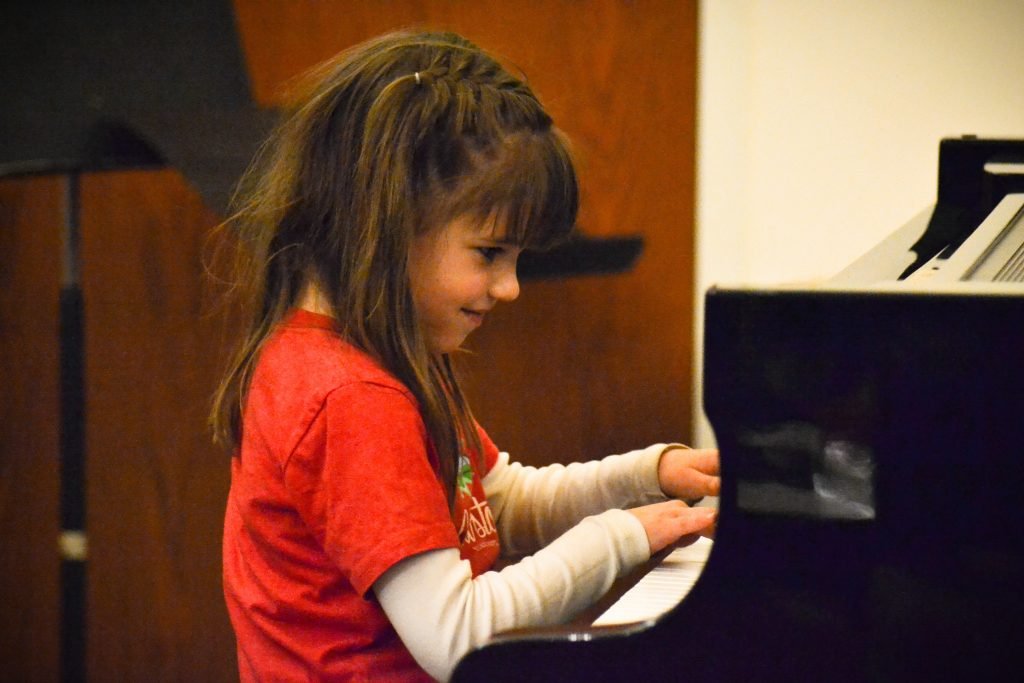
Last Saturday evening (5/5 @ 5PM!) was our spring recital. I swear these recitals come around faster every year.
(“Is the recital going to be at that ‘Ten Thousand Stars Church?’” one kid asked me. “Well, yes, it is,” I answered with a straight face, liking the inflated notion that now my studio had its own church. I must confess that sometimes, I lie. Especially when it is funny.)

Some time ago, a student asked me if we couldn’t someday have a recital that featured the music of a single composer. I thought this a brilliant idea, and immediately tried to book Beethoven for the event. Turns out, it is hard to get old Ludwig to commit to a date.
Truth is, Beethoven would have been a highly inappropriate choice. Beethoven, in spite of his genius, did not write music for the young beginning pianist. Nor was he much concerned with making his music particularly “pianistic”. He couldn’t have cared less to write a piece that was heavily patterned in such a way to make it sound more difficult and impressive than it was. No, when it comes to those little things that give ease and confidence to young musicians, Beethoven was a tough cookie.
Which is why I am once again eternally grateful for Dennis Alexander.
Several years ago (six to be exact), my friend Anne stood in my kitchen and announced, “You will never guess who just moved to Albuquerque. Dennis Alexander!” To which I responded, “It can’t be that Dennis Alexander.”
To our great fortune, it was.
Since that time, Dennis has become not only a colleague and mentor, but also a friend. Indeed in my world, Dennis is right up there with Beethoven. Hardly a day in the last 20 years has gone by when I haven’t taught one of his great pedagogical gems.
Over the years, my students have had the great privilege of trying out music he has written before it has been published. He has guided me through thorny pedagogical dilemmas, offered feedback to my own performances, coached my students before important events. And as every kid knows when we play Musical Trivia Pursuit in performance class, “Dennis Alexander” is the answer to the question: “Who is the composer who recently moved to Albuquerque?” (Lately, however, the kids have been arguing this point, telling me that Dennis Alexander did NOT “recently” move to Albuquerque, but has lived here “a LONG time.” Just goes to show you “a LONG time” is different when you are 7 then when you are almost 40!)
But even more importantly than all those things, Dennis graciously agreed to come to our recital last Saturday night.
And so, the 5/5 @ 5PM recital featuring the music of Dennis Alexander was born.
Last Saturday there were performances of the old favorites from the Finger Paintings collections, which were among the first pieces of Dennis’ I ever taught.
There were several duets performed that night that came from a new, just published, collection of duets: Just for Two, which are duet arrangements of his popular Just for You books.
A left hand injury inspired me to teach the fiendishly difficult, but lovely “Arioso for the Right Hand” to one high school student. Working on this piece together led this otherwise cool teenager to exclaim, “Oh! It is so beautiful!” That alone was worth all the struggles we have gone through together for it was the first truly unguarded and touchingly vulnerable response I had witnessed from her in years.
My favorite moment involved a brother/sister team who played “Giggle Bugs” from one of the aforementioned Finger Paintings books. The older sister played the teacher part, exactly like I did for HER seven years ago on her first recital. It seems we have come full circle, and beyond that, it appears I might be teaching myself out of a job.
Afterwards there was the predictable punch and cookies, photos were taken, children ran around in recital clothes letting off steam, parents breathed a sigh of relief that yet another recital performance was behind us. Dennis posed for pictures and signed dozens of autographs. (One tiny child seemed confused by this concept, and kept bringing her program to me to sign. “Kid,” I finally said, “my autograph is worth nothing. Nothing, I tell you.”)
Even on evenings when I am not particularly anxious about the students’ performances, even when I can sit back and relax confidently knowing that the kids have got things under control, even when I can honestly say we are as ready as we could be at this particular time, even when all that, these studio recitals still take an enormous amount of energy. The good will generated at these events is worth every ounce of time and effort, but nevertheless it is somewhat a distraction from the work we otherwise do week in and week out.
It’s time to get back to the business of learning to be a musician again….
May 6th, 2012 :: Ordinary Days
Outside the window, the roses wave in the sunlight....
The table and chairs beckon, waiting for the first al fresco lunch of the season...
The courtyard, which just weeks ago was covered in snow....
....now is bursting with green....
Pink tulips stand at attention....
The orange poppies are rioting for space and attention....
The hollyhocks are staking their claim everywhere.....
Purple alliums look like giant lollipops....
The roses climb up the walls....
The back garden sits quietly under the shade of the elm treess.....
Yellow Lady Bank roses fall over the trellis....
Brightly colored chairs lure us out in the evenings, to sit and linger in the fading New Mexico light, cocktails in hand....

April 29th, 2012 :: Teaching Days
This week I was teaching a pre-Impressionist piece to Sophie. It is a little early intermediate piece that makes use of the five-note pentatonic scale. I began my spiel by talking a bit about Impressionist art. We looked at a couple of paintings by Monet in an art book. I explained the link to Impressionist music, how these composers were enthralled with Asian culture, and how they began imitating this sound by using modalities like the pentatonic scale. We improvised a bit on the black keys, familiarizing ourselves with this distinct sound color. I reminded Sophie that at this time in history it was difficult to travel from Europe to the Far East and so composers had a fairly limited knowledge of this culture. I was ready to direct our attention to the actual piece that I was assigning Sophie, confident that I had done my background work thoroughly.
Suddenly, Sophie blurted out, "Couldn't they just go through the Panama Canal?"
Of course not, I thought impatiently, my eyes on the clock. Don't they teach you anything at school? This was already taking far longer than I had anticipated. Next week is our spring recital, there is a lot to do. This juggling act of time management is a constant negotiation. We need to work deeply on a few things, such as the upcoming recital piece, and yet, at the same time, I can’t ignore the regular practices of technique work, sight-reading, new repertoire, and so on. If I do, the students will be certain to ignore these things as well.
There is no right answer as to how to divvy up our allotted time together. Sometime I divide and conquer well, balancing tasks with poise. More often I’m afraid that I push through hurriedly, and probably squash some natural curiosity that might have arisen if I had only allowed a bit more space and breath in our work. Last week, in a rare moment of grace, I decided not to brush off Sophie’s innocent question. Instead, we got out the atlas and examined the map to understand why the Panama Canal was totally unhelpful to the French trying to get to the Far East.
Total time: 43.5 minutes.
Perhaps not the most linear or direct use of our time. In fact, this might be the pedagogical parallel to going through the Panama Canal on the way to the Far East. But I wonder, how much do we miss in our quest for efficiency? I suspect that if we sometimes slowed down long enough for the journey, we might discover that the Panama Canal is actually quite beautiful.
April 22nd, 2012 :: Practicing Days
Recently, one of Matt’s choirs performed a piece called “Immortal Bach” arranged by the Norwegian composer Knut Nystedt. This work is based on a Bach chorale, which is sung twice. The second time is the particularly interesting one.
The second time, the singers are instructed ignore the notated rhythm of the chorale, and instead to randomly hold each note for various lengths of time (2 seconds, 4 seconds, 10 seconds, etc.) before moving to the next pitch. This creates, of course, a series of dissonant sounds as each phrase progresses to its cadence. The tension between the thick dark dissonance and the resolution is striking; each phrase becomes a kaleidoscope of sound, the colors shifting almost imperceptivity.
This whole concept got me thinking. While singing this piece, I realized that such magnification of harmony changes allowed the performer to get inside the sound in a profound way. My friend and musical partner Jerome often talks about “inhabiting the music”. This performance of “Immortal Bach” was habitation like I had never experienced before.
This concept of stretching a piece beyond measure is not new. In 1987, John Cage wrote a piece for organ called Organ/ASLSP (As SLow aS Possible). A performance of this piece in Halberstadt, Germany began on September 5, 2001 with a rest lasting 17 months. The whole performance is scheduled to last 639 years, ending in 2640. That’s slow.
A recent trend in electronic music digitally stretches recordings until they are lengthened beyond recognition. Other slow movements---slow living, slow food—have been around for a while now; perhaps it is time for practicing to join the bandwagon. Which leads me to another practice technique: Slow Practice. Slow practicing is nothing new; goodness knows that every music teacher on the planet screams, “slow down!” at least ten times a day. But what about extremely slow practicing? How might that work to shift our perception, not only of the sound, but also the gestures and physical movements required?
We are in too much of a hurry, all of us. Certainly my students reflect our general hastiness, getting them to slow down takes an act of congress. That old musician’s standby, the metronome, slows us down to be sure, but sometimes I resist its forced rigidity. After all, I don’t necessarily simply want slow, I want slow and thoughtful, which doesn’t necessarily mean metronomic. In my studio, we call slow practice “Slow-mo.” Slow-mo, I write in the students’ notebooks, knowing full well that this means different things to different kids. Usually slow-mo is not really very slow at all, but occasionally a kid will be very taken with the idea, at least for five seconds before they get bored.
Slow Practice is a hard practice, not for the faint of heart, I have discovered. It’s difficult to slow down, our impatience and our busyness rule the day, forcing us into faster and faster modes of thinking and doing. Slow---really slow---is as uncomfortable as it is enlightening, which is probably all the more reason to do it. Taking time, loads of time, many seconds per sound or movement, forces us to really examine what we are doing, builds brain and muscle connections in new ways, blows apart our preconceived expectations. How did I really get from this chord to that one? What happens in between this motive and that one? What is that left hand actually doing during that strange transitional passage? When we slow down and really notice our work, we start to learn the answers to these kinds of questions, changing not just our music or our performances, but our very selves, in subtle and profound ways.
April 15th, 2012 :: Traveling Days
I have just returned from a week in NYC where spring was everywhere.
Daffodils were trumpeting from every corner…
Hyacinths were blooming…
Trees in the parks were bursting with color…
Tulips were rioting for attention…
I spent a few days in a conference, where, I must confess, I went to only one session (perhaps a personal all-time low). Instead, I met up with a number of dear friends (also supposedly attending the convention) and had long deep, thought-provoking conversations over lunches and many cappuccinos.
On Wednesday morning, I gave a presentation on motivation and the music lesson at the conference to a wonderfully enthusiastic crowd who had honored me by getting up at 8AM on the last day of the conference and didn’t even yawn.
(For those still interested, you can download my handout here….)
I hung out with parents, sisters and baby nephews in parks…
gardens….
zoos…
and restaurants….
My sisters and I had girl’s night out in the city. The first since their babies and husbands appeared on the scene.
I saw no shows on Broadway, but did see “Fame” at St Ignatius Loyola on the Upper East Side where my sister Beth teaches. That is almost like Broadway.
I heard a reading in a private room with Aasif Mandvi, the correspondent from The Daily Show. He was funny. “Did you meet him?” Matt asked me eagerly when I reported my close celebrity encounter. Well, no. I could have, but that evening I was moving from my cool trendy hotel to my sister Sarah’s apartment in New Jersey. I was carrying a backpack and looked like I had spent the last three months hitchhiking across Europe. I actually tried to avoid meeting him.
I survived night duty with my baby nephew Felix, who giggled every time he threw his pacifier across the room and hit my sleeping head.
I endured two 10-12 hour travel days (there is NO easy way to NYC from Albuquerque, but this time I might have managed the worst possible schedule imaginable.). Flying over the mountains, we circled around Albuquerque three times because of bad winds. Finally, the caption came over the loudspeaker and said:
“OK folks, we are going to try this one more time, and then we are going to divert to Amarillo.”
At that point, I almost burst into tears.
Thankfully, that last try was successful.
(“Where is Amarillo anyway?” one woman asked as we were getting off the plane. “Not close,” someone answered curtly.)
I arrived home to my own colorful garden….
Only to wake up the next day to an unexpected spring snow!
It’s good to be home.
|